WATER EFFICIENCY
Flow Dynamics
Smart Valve
Delivered & Supported by Effective Connect
Precision Flow Conditioning | Mechanical Efficiency | Real-time Analytics
Flow Dynamics Smart Valve Technology
Core Solution Provided by On Track Technology Solutions
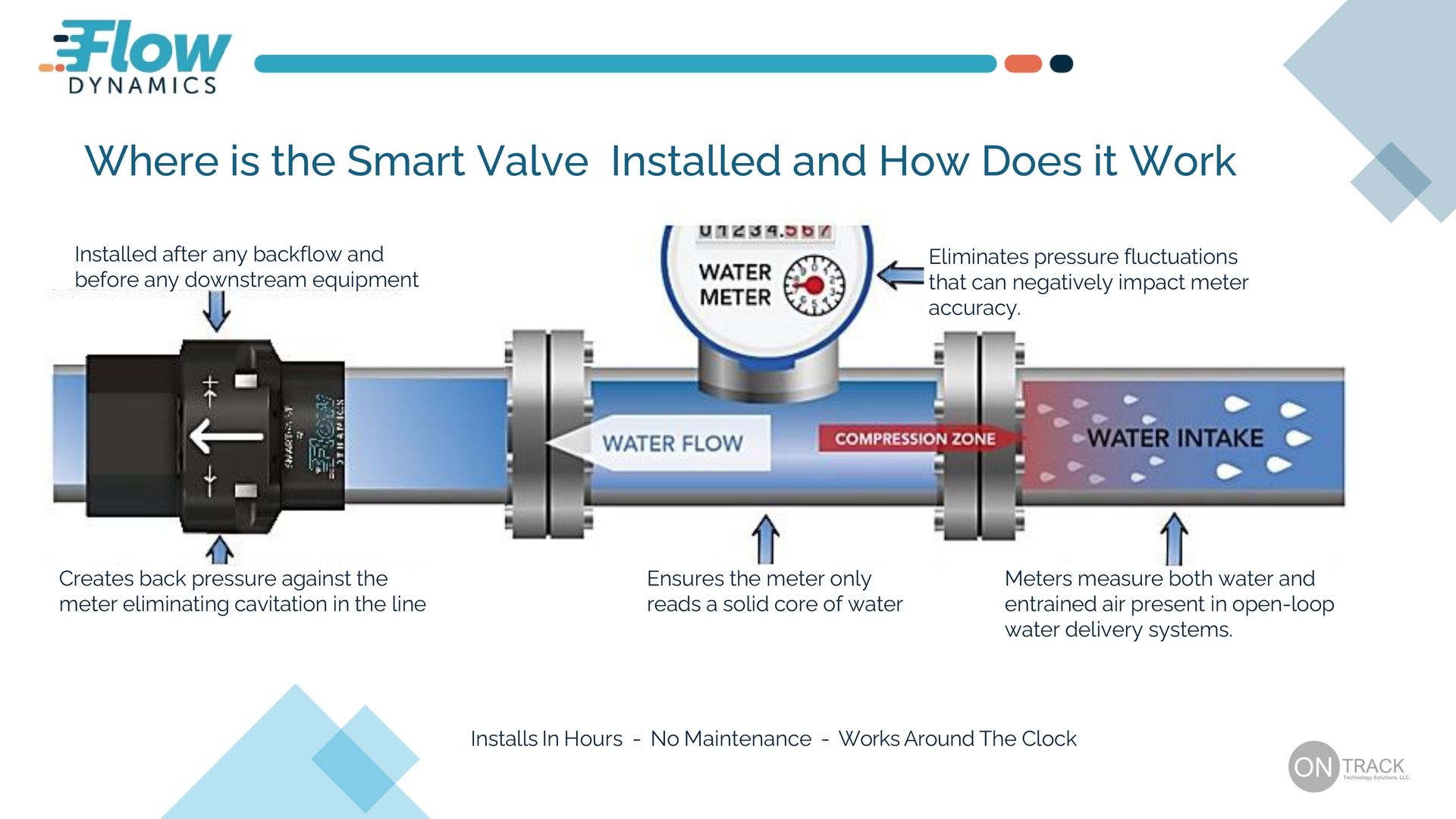
The Flow Dynamics Smart Valve is a non-restrictive, mechanically engineered device designed to stabilize hydraulic
behavior within domestic water systems. The valve absorbs pressure fluctuations, eliminates turbulence, and reduces
velocity-driven over-registration at the utility meter.
Key technical characteristics and benefits:
- Hydraulic pressure stabilization: Dampens transient spikes caused by fluctuating demand, reducing stress on
- piping, fittings, valves, and meters.
- Turbulence and cavitation reduction: Conditions flow into a laminar profile, improving volumetric accuracy and
- minimizing mechanical wear downstream.
- Volumetric efficiency improvement: Reduces total water and sewer usage by 15–35%, depending on system
- design and demand profiles, without limiting fixture performance or occupant experience.
- Non-restrictive design: Maintains flow rates while controlling velocity and pressure dynamics.
- Industrial-grade construction: Aerospace-grade stainless steel internals ensure long-term durability in corrosive,
- high-pressure, or elevated-temperature environments.
+ bluebot Analytics & AI Monitoring
For operators seeking real-time system visibility, performance validation, and portfolio-level reporting, On Track Technology
Solutions can integrate the Flow Dynamics Smart Valve with an AI Analytics Dashboard.
Platform capabilities include:
- Live flow and pressure monitoring: High-resolution digital sensors capture flow, pressure, and temperature data
- at sub-minute intervals.
- AI-based pattern analysis: Machine learning models identify abnormal consumption patterns, pressure
- anomalies, or emerging inefficiencies.
- Predictive maintenance insights: Baseline operating conditions are established and continuously compared to detect deviations associated with valve wear, leaks, or system degradation.
- Water-to-cost analytics: Converts volumetric usage into dollar-based metrics to validate savings and support budgeting and ROI analysis.
- Multi-site portfolio management: Centralized dashboard for benchmarking performance across buildings, regions, or asset classes, with optional ESG and sustainability reporting.
Performance
Outcomes
- 15–35% reduction in water and sewer consumption driven by mechanical flow conditioning.
- Reduced pressure-related failures and extended infrastructure lifespan.
- Optional real-time and historical system visibility when analytics are deployed.
- Data-supported savings verification for finance, sustainability, and compliance teams.
- Alignment with ESG, LEED, and BOMA water efficiency benchmarks.